When an Aspie tries to make systematic sense of potentially complex
family relationships, intriguing questions can emerge. On the one hand,
this may seem a rather esoteric issue; on the other hand, because of
the importance of relationships, the strong emotions associated with
certain relations, and the obligations one may feel both to the family
as a whole, to the central connector between oneself and another, and to
"connectee," I am wondering if these are problems that real people
actually struggle with.
Ever thought of this one? Suppose that Amy has a mother-in-law named
Alice and a sister named Abby. Alice can refer to "my daughter-in-law's
sister" as a way to specify their relationship, but that is a rather
lengthy description for a relationship that could be rather close in
some situations. In the U.S., many would probably see any strong
relationship between Alice and Abby as being somewhat optional. It's great if they get along well, and their family connection could allow them to bond over a shared interest or perspective. Ironically, for example, although Amy may be on quite favorable terms with Alice, Alice may actually end up spending more time with Abby if the two of them share a passionate interest in digital photography. If Abby is the younger sister and Alice only had sons, she could also emerge as "the daughter I never had."
In some
cultures, there may be norms requiring the acknowledgement of a rather
explicit relationship, and, as such, a term such as "niece-in-law"
could emerge--both as a shorthand and a as way of acknowledging the
centrality of the relationship. Rather than quickly picking up the nature of the relationship from familiar shorthand, confusion would set in.
Hearing someone express this rather bizarre term could be seen as an
attempt to be innovative, philosophical or as an attempt at humor. Yet, if the
relationship comes up repeatedly in conversations, "my daughter-in-law's
sister" really does become rather cumbersome.
Alice, faced with being a
mother-in-law for the first time, may wonder if the if there is a concise way she way for her to refer to a relation likely to be important to her daughter-in-law. But, as a means of expediency, if Alice finds herself repeatedly referring to Abby, how much freedom does she have to innovate around the long and cumbersome relationship description? Could she light heartedly refer to her "nice-in-law" with her friends until that term becomes understood? Could she legitimately attempt to establish Abby as a person in her own right--with a concise name of her own--or would this be an egregious evasion of a relationship that exists and should be acknowledged? Would thinking of the individual Abby rather than the family member
either make Alice feel guilty for favoring expediency over deeper
meaning, or could it make her feel more enlightened? And is any violation against Abby, her sister, Amy's husband, or the family as a whole?
Does Alice have a
greater obligation to ponder her relationship to Abby than vice versa,
either because of the role as elder person in the hierarchical relationship between
mother-in-law and daughter-in-law, or perhaps because Amy only has one
mother-in-law but could potentially have several sisters, possibly
diluting the importance that any one sister of one's daughter-in-law
might have? Or, does Abby have an obligation to defer to Alice? Do the
two of them try to sort out this issue between themselves, perhaps
reducing tension by laughing as they muse at the complications of life? Knowing the
kinds of complications that Amy has thrust on these two women as a
result of her marriage, what kind of responsibility does Amy have for
helping these two people--each important for her--figure out their
relationship to each other?
For men--who do not face quite as
much pressure to understand and consider relationships--is the issue of
the meaning of "my son-in-law's brother" less significant? And what
happens when things get complicated as a man refers to "my
daughter-in-law's brother?"
Once we have resolved this issue, we can ponder the nature of the "aunt-in-law" relationship.
Friday, August 28, 2015


Friday, May 23, 2014
The End of an Era
On Tuesday night, after I had turned in my grades for the semester, I walked through the University Village across the street from campus. The Village is slated for redevelopment over the next one and a half decades. This is expected to be one of the largest--if not the largest--development projects in the Los Angeles area for much of this time.

The increasingly deserted state of the Village probably should not have come as a surprise to me. Sometime ago, it had been announced that all but a few of the merchants were now on month-to-month leases. Last week, I received a letter from Bank of America indicating that my branch--located in the Village--would be moved. Yet, I had not realized that the exodus would happen so suddenly.
A year or two ago, we got a new Radio Shack in the Smart & Final shopping center across from campus on the West. It had not occurred to me that this would not be a new "bonus" location that might have other items on sale and closeout than the one in the Village. Now, however, I noticed a sign announcing the impending closure of the Village location. The sign reminded customers that things could still be bought online.
Since returning to USC in 2006, I have periodically made strategic stops at the 99 cent store in the Village. Over the years, I have bought a number of plastic envelopes to store student in-class assignment materials. When visiting, I would always check if they had received new ones with new colors that could be distinguished from the ones I already had. There were other neat things that could be bought at low prices. I am not really very good at matching socks (or at least I am not very conscientious in tackling this burden), so it was often tempting to find eight to ten identical pairs of socks that would postpone a shortage of clean, matched socks for a while. But the 99 cent was no more. It had been closed without anyone asking for my opinion--let alone consent--in the matter. I had been there just a few weeks ago with no sign of the impending implosion. One would have hoped that the owners would at least have tried to invite regular customers to a spectacular closeout. But no; maybe they found a new location. Yes, there are other 99 cent stores around, but none located as conveniently.
I thought I would check out the supermarket named (not very accurately) Superior. If you could stand the smell, you could often get very good deals there. They had a bakery, so this is where I would usually pick up cakes for celebrations. Even in recent times, you could often get very good deals on fruit. Back in the old days when I was a doctoral student, the place was called Notrica's and one could get truly exceptional deals on produce. This had not been as much the case in their more recent incarnation, but I still wonder where I will now find low priced Italian prunes in the neighborhood. Yes, I knew that Superior would eventually close, but I did not realize it would happen so soon. And I do worry about where many locals will shop. The place used to be rather busy, and it does not seem that there are any other supermarkets nearby. Hopefully, funds set aside by the University as part of the project to mitigate such community impacts will help bring about a reasonably priced replacement.
The nutritional supplement store had been closed for more than a year. I would occasionally shop there when I needed things like echinacea and golden seal. The store was owned by a very philosophically inclined gentleman who was likely from the West Indies. Such a store had probably proven difficult to sustain when many of his specialty items can today be procured online. The Village--way back when I was a doctoral student in the 1990s--had also had a record store, but that had disappeared years ago.
I do not remember if the theater was still in business. In all my years of USC, I had actually only been there once--when Michael Crichton's Congo had was released in film.
Ironically, the photo developing show had been around until recently. They still offered the printing of large photos and occasional film processing, years ago, they had seen the writing on the wall and had started a sideline of computer and cell phone repair that had eventually become their main focus.
On the outer periphery, Starbucks, Denny's, and Baskin-Robbins were still up and operating, and at Starbucks, the line was long despite the fact that many of the students had left for the summer. But overall, the Village seemed deserted.
As much as I am tempted, I know I can't fairly blame the Communists--or even the Bruins--for the current state of affairs. This is, after all, a stage in the redevelopment efforts that will help revitalize the neighborhood. But coming right upon the realization that I would not get to give another exam until sometime in October, the experience did make me very nostalgic.

The increasingly deserted state of the Village probably should not have come as a surprise to me. Sometime ago, it had been announced that all but a few of the merchants were now on month-to-month leases. Last week, I received a letter from Bank of America indicating that my branch--located in the Village--would be moved. Yet, I had not realized that the exodus would happen so suddenly.
A year or two ago, we got a new Radio Shack in the Smart & Final shopping center across from campus on the West. It had not occurred to me that this would not be a new "bonus" location that might have other items on sale and closeout than the one in the Village. Now, however, I noticed a sign announcing the impending closure of the Village location. The sign reminded customers that things could still be bought online.
Since returning to USC in 2006, I have periodically made strategic stops at the 99 cent store in the Village. Over the years, I have bought a number of plastic envelopes to store student in-class assignment materials. When visiting, I would always check if they had received new ones with new colors that could be distinguished from the ones I already had. There were other neat things that could be bought at low prices. I am not really very good at matching socks (or at least I am not very conscientious in tackling this burden), so it was often tempting to find eight to ten identical pairs of socks that would postpone a shortage of clean, matched socks for a while. But the 99 cent was no more. It had been closed without anyone asking for my opinion--let alone consent--in the matter. I had been there just a few weeks ago with no sign of the impending implosion. One would have hoped that the owners would at least have tried to invite regular customers to a spectacular closeout. But no; maybe they found a new location. Yes, there are other 99 cent stores around, but none located as conveniently.
I thought I would check out the supermarket named (not very accurately) Superior. If you could stand the smell, you could often get very good deals there. They had a bakery, so this is where I would usually pick up cakes for celebrations. Even in recent times, you could often get very good deals on fruit. Back in the old days when I was a doctoral student, the place was called Notrica's and one could get truly exceptional deals on produce. This had not been as much the case in their more recent incarnation, but I still wonder where I will now find low priced Italian prunes in the neighborhood. Yes, I knew that Superior would eventually close, but I did not realize it would happen so soon. And I do worry about where many locals will shop. The place used to be rather busy, and it does not seem that there are any other supermarkets nearby. Hopefully, funds set aside by the University as part of the project to mitigate such community impacts will help bring about a reasonably priced replacement.
The nutritional supplement store had been closed for more than a year. I would occasionally shop there when I needed things like echinacea and golden seal. The store was owned by a very philosophically inclined gentleman who was likely from the West Indies. Such a store had probably proven difficult to sustain when many of his specialty items can today be procured online. The Village--way back when I was a doctoral student in the 1990s--had also had a record store, but that had disappeared years ago.
I do not remember if the theater was still in business. In all my years of USC, I had actually only been there once--when Michael Crichton's Congo had was released in film.
Ironically, the photo developing show had been around until recently. They still offered the printing of large photos and occasional film processing, years ago, they had seen the writing on the wall and had started a sideline of computer and cell phone repair that had eventually become their main focus.
On the outer periphery, Starbucks, Denny's, and Baskin-Robbins were still up and operating, and at Starbucks, the line was long despite the fact that many of the students had left for the summer. But overall, the Village seemed deserted.
As much as I am tempted, I know I can't fairly blame the Communists--or even the Bruins--for the current state of affairs. This is, after all, a stage in the redevelopment efforts that will help revitalize the neighborhood. But coming right upon the realization that I would not get to give another exam until sometime in October, the experience did make me very nostalgic.
Tuesday, November 12, 2013
Seven ramdom pieces of info about me...
A Facebook friend assigned to provide seven random pieces of information
about myself. Here we go:
1. One of the ways I learned English was to listen to
shortwave radio before coming to the U.S. and speaking on the CB radio once
here.
2. I have never been to Alabama, Omaha, Burkina Faso, or
Egypt.
3. There was no yellow submarine--at least that I am aware
of--in the town where I was born.
4. I believe that the World would be better off without
communists, alcohol, and adulterers.
5. I like to listen to Supreme Court oral arguments.
6. I used to be somewhat judgmental.
7. The last two times I rented a car were in 2000 and 2005.
On the latter occasion, the AM band did not work on the car radio, but when I
got within the reach of an FM station, I heard for the first time in the news
about the nomination of John Roberts to replace Sandra Day O'Connor (which was
subsequently changed to the nomination to replace William Rehnquist as Chief
Justice after his passing)
Wednesday, November 06, 2013
How, exactly, does the Earth's tilt cause the seasons?
Different
individuals on the autism spectrum are impacted in different ways. The one area
in which I am severely impaired is spatial perception. I do not have good
intuition in this area and I have real difficulty reasoning myself through
spatial transformations. People will give me directions to a destination and
say "You can't miss it!" Unfortunately, my response is going to be
"Oh yes, I can!" Ever since I first learned about the Earth's tilt in
elementary school, I have been aware that Earth's seasons are somehow related
to the tilt of the Earth. Yet, until today, I have never been able to
understand how, in reality, the tilt brings about the change in seasons as the
Earth rotates around the sun. I have never doubted the truth of this
explanation and never suspected that there was some conspiracy going on to
mislead the population. I just didn't understand what was going on. I have
tried to read a number of descriptions and observed numerous animations. Until
today, I still ended up walking away without understanding the explanation.
However, after watching this lecture, I finally understand (sort of, at least):
https://www.khanacademy.org/science/cosmology-and-astronomy/earth-history-topic/earth-title-topic/v/how-earth-s-tilt-causes-seasons
.
Friday, September 27, 2013
Is authentic cool?
Many well meaning people will often praise an ethnic restaurant as being "authentic"--i.e., true to the actual cuisine of a particular country or region. Somehow, "authentic" offerings are seen as being of higher quality and more desirable than the ones that have somehow "sold out" or "caved" to the tastes of the masses.
Authentic may be politically correct, but does it actually taste better? Granted, in some cases, authentic restaurants may go through more elaborate preparations that restaurants that seek to reduce costs opt to skip. Perhaps they would not have been able to get away with this "back home." I am not in favor of mediocrity. I just refuse to be against innovation and improvement as a matter of principle. The dinosaurs died out for a reason. So will many cultures that refuse to learn from the American way. (And our culture could, too, if we are not open to innovations from the outside).
Certain individuals maintain an adamant sense of superiority that they can "hack" the "real thing" rather than having to resort to something that has been "watered down" to meet sissier Western tastes. I am the first to agree the reducing the spice on Indian food is a pathetic accommodation to those who can't handle truly hot food. Other adaptations clearly make more sense, however.
There are large variations in taste around the World. Tastes are to some extent acquired; we "learn" to like certain foods that we have grown up eating. (There is also an evolutionary predisposition toward a preference for sweet and fatty foods, a remnant from times when it was in the interest of survival to maximize caloric intake while food was available). To the extent that changes have been made to dishes at "inauthentic" restaurants, these may, in fact, better accommodate the tastes of the vast majority of consumers in the "target" country. Yes, it looks like American foods are being messed up in other countries when they add all sorts of yucky ingredients to the real thing, but it unfair to expect people who have grown up to like yucky stuff to appreciate unyucky alternatives. There really is no reason why the Japanese should eat American foods sweeter than they prefer just to stay true to the American origin of the fare. Neither should Americans be subjected to a limited assortment of toppings for a food item just because people in country of origin didn't feel as much of a need to satisfy a desire for choice and individual differences in taste.
Some purists may feel that fusion cuisine is heretical and somehow uncultured. I have no problem if they want to stick with the "authentic" thing, but I am not impressed by their commitment to principle and their snide insinuations that they are more enlightened. Innovation and adaptation are cool!
Authentic may be politically correct, but does it actually taste better? Granted, in some cases, authentic restaurants may go through more elaborate preparations that restaurants that seek to reduce costs opt to skip. Perhaps they would not have been able to get away with this "back home." I am not in favor of mediocrity. I just refuse to be against innovation and improvement as a matter of principle. The dinosaurs died out for a reason. So will many cultures that refuse to learn from the American way. (And our culture could, too, if we are not open to innovations from the outside).
Certain individuals maintain an adamant sense of superiority that they can "hack" the "real thing" rather than having to resort to something that has been "watered down" to meet sissier Western tastes. I am the first to agree the reducing the spice on Indian food is a pathetic accommodation to those who can't handle truly hot food. Other adaptations clearly make more sense, however.
There are large variations in taste around the World. Tastes are to some extent acquired; we "learn" to like certain foods that we have grown up eating. (There is also an evolutionary predisposition toward a preference for sweet and fatty foods, a remnant from times when it was in the interest of survival to maximize caloric intake while food was available). To the extent that changes have been made to dishes at "inauthentic" restaurants, these may, in fact, better accommodate the tastes of the vast majority of consumers in the "target" country. Yes, it looks like American foods are being messed up in other countries when they add all sorts of yucky ingredients to the real thing, but it unfair to expect people who have grown up to like yucky stuff to appreciate unyucky alternatives. There really is no reason why the Japanese should eat American foods sweeter than they prefer just to stay true to the American origin of the fare. Neither should Americans be subjected to a limited assortment of toppings for a food item just because people in country of origin didn't feel as much of a need to satisfy a desire for choice and individual differences in taste.
Some purists may feel that fusion cuisine is heretical and somehow uncultured. I have no problem if they want to stick with the "authentic" thing, but I am not impressed by their commitment to principle and their snide insinuations that they are more enlightened. Innovation and adaptation are cool!
Thursday, May 23, 2013
Everyday [was] a savings day for Thrifty people!
Call me nostalgic, but I'm still not over the demise of the Thrifty chain. Yes, the takeover by RiteAid was in 1996, but what can I say? I am slow to accept change. It's not that I am dissatisfied with RiteAid--they often have great sales--but it's just sad when all that is left of the old Thrifty is the name of the store ice cream brand.
It used to sound so reassuring to hear the old jingle "Everyday's a savings day for thrifty people!"
They also had a rather memorable advertisement back in the days of old fashioned film. An older woman calls her son to talk about some pictures he sent. For those born fewer than thirty years ago, yes, old fashioned print photos sent by snail mail. Although the woman recognizes her daughter-in-law and the grandchildren, she does not recognize one of the characters in the photos. The man explains that he grew a beard. The mother then announces that she is sending the photos back. "You're sending the photos back because I grew a beard?" the man asks incredulously. "No, for your album," the mother explains. The man then happily tells his mother that she can keep the photos because Thrifty offers double prints. The woman is perplexed. "Trifty?" she asks in a polish accent, clearly unaware of the giant chain. At end of the call, the man expresses his love in Polish.
Am I being to sentimental? Probably, but I am also disappointed that the Bank of A. Levy was taken over many years ago by First Interstate. They had great commercials where they represented themselves as "the boring bank." In one, a man called up making a case for how boring he was, hoping that he would be eligible to set up an account. They told him to relax, that he did not have to prove that he was boring. They were the boring bank because they took care of the boring stuff for their customers.
It used to sound so reassuring to hear the old jingle "Everyday's a savings day for thrifty people!"
They also had a rather memorable advertisement back in the days of old fashioned film. An older woman calls her son to talk about some pictures he sent. For those born fewer than thirty years ago, yes, old fashioned print photos sent by snail mail. Although the woman recognizes her daughter-in-law and the grandchildren, she does not recognize one of the characters in the photos. The man explains that he grew a beard. The mother then announces that she is sending the photos back. "You're sending the photos back because I grew a beard?" the man asks incredulously. "No, for your album," the mother explains. The man then happily tells his mother that she can keep the photos because Thrifty offers double prints. The woman is perplexed. "Trifty?" she asks in a polish accent, clearly unaware of the giant chain. At end of the call, the man expresses his love in Polish.
Am I being to sentimental? Probably, but I am also disappointed that the Bank of A. Levy was taken over many years ago by First Interstate. They had great commercials where they represented themselves as "the boring bank." In one, a man called up making a case for how boring he was, hoping that he would be eligible to set up an account. They told him to relax, that he did not have to prove that he was boring. They were the boring bank because they took care of the boring stuff for their customers.
Sunday, September 02, 2012
Dogs
Over the years, my family had a number of dogs.
Our first dog had a bit of a temper. It went into a rage any time visitors came by. You could see that the paint was bitten off the window frames in the living room as he faced the frustration of not being able to get at the intruders.
Let me first tell this story the way I thought it went and then make the correction that my mother brought up when I related the story many years later. The dog, named Attacker, liked to bite at my sister's dress. One day, my sister came to report this problem to my father: "Attacker bite Nettie!" My father, deeply absorbed in his newspaper, distractedly replied back "Nettie bite Attacker!" A moment later, we heard a scream from the other room, and my sister Anette came back spitting hair out of her mouth.
When I related this story, my mother told me that although the Danish name of the dog indeed sounded like Attacker, it actually meant Furball. But the story would not have been as interesting told that way.
Next, we got two Golden Retrievers--Nuser and Vaks. Nuser some behavioral problems--I no longer remember the details--and we ended up giving him to one of the ranch hands. One time, we kept one of Vaks' puppies. Because of her large spot, we named her the Danish equivalent of Spottie. Then we got a Swiss Mountain Dog named Carla (minus the brandy flask on the collar). We brought these three dogs with us when we moved to California in 1978.
Vaks and Spottie enjoyed roaming around. They would often be gone for twenty-four hours or more. Our house was up on a hill, below which on the one side was the barn. Although the dogs liked to run on long trips, they did not feel like walking back up the hill to the house afterward, so they would wait for my mother to drive down to pick them up. My mother sensed Vaks' resentment when she did not come quickly enough.
My mother had promised my youngest sister, Pernille, a poodle after we moved to California. Unfortunately, the poodle passed away a few days after we got it. For some reason, Pernille ended up choosing a wire haired Fox Terrier--the dog that Tin Tin had--as the replacement. Change, however, has never been my strong suit, so I continued to refer to the new dog--Snoopy--as "the poodle." Other members of the family corrected me for years, but my I persisted. Finally, one day when I told Snoopy that "You're a bad poodle!" my mother finally relented, saying, "No, she's a good poodle!"
Vaks and Carla eventually passed away while we lived in Paso Robles. Spottie lasted for a number of additional years. One year, we exhibited the horses at the California State Fair and had a booth. Spottie had just had puppies, and we brought them all along. A little girl walked by our booth and was overtaken with disgust. "Eew! Those a pigs! I bet they smell!" she cried out with indignation.
One night, my mother had a dream that we acquired a new "poodle" or Fox Terrier. I got to name her and chose the name Profit. Several years later, some missionaries came by. Profit ran out when Pernille opened the door. "That's a beautiful name!" exclaimed the missionaries as Pernille called her back. Pernille did not have the heart to tell them about the spelling of the name.
As she grew older, Spottie spent most of the day sleeping. My mother said that she was not looking forward to having to call me when she passed away. She actually got out of that obligation as she was just about to leave on a trip as it happened and delegated the task.
As the other dogs passed away, Profit became the lone surviving dog. When my mother was eating, Profit would approach. She was so confident that my mother would slip her a treat that she started wagging her tail before my mother delivered.
Profit was rather energetic. Unfortunately, she tried to jump out of a car with an open window and, being on a leash, ended up strangling herself.
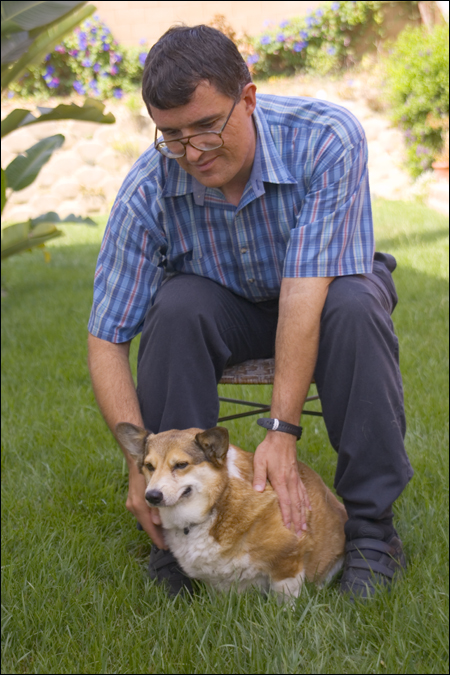
My mother then acquired a Welsh Corgi. We named him buck. My mother said that she had deliberately chosen the humblest member of the litter, but he was the humblest only by default. He never realized that my mother was the one who fed him and that he had probably better stay on her good side. It turned out that my mother never cut his food rations no matter his non-compliance, so he may have gotten the last laugh.
A corgi is supposed to have a life expectancy of some ten years. About five years ago, my mother started to prepare me that Buck might not be with us much longer, but I saw no sign of decline and expressed my doubts. Eventually, he started to cut down his activity level significantly, but he lasted until age fifteen.
Our first dog had a bit of a temper. It went into a rage any time visitors came by. You could see that the paint was bitten off the window frames in the living room as he faced the frustration of not being able to get at the intruders.
Let me first tell this story the way I thought it went and then make the correction that my mother brought up when I related the story many years later. The dog, named Attacker, liked to bite at my sister's dress. One day, my sister came to report this problem to my father: "Attacker bite Nettie!" My father, deeply absorbed in his newspaper, distractedly replied back "Nettie bite Attacker!" A moment later, we heard a scream from the other room, and my sister Anette came back spitting hair out of her mouth.
When I related this story, my mother told me that although the Danish name of the dog indeed sounded like Attacker, it actually meant Furball. But the story would not have been as interesting told that way.
Next, we got two Golden Retrievers--Nuser and Vaks. Nuser some behavioral problems--I no longer remember the details--and we ended up giving him to one of the ranch hands. One time, we kept one of Vaks' puppies. Because of her large spot, we named her the Danish equivalent of Spottie. Then we got a Swiss Mountain Dog named Carla (minus the brandy flask on the collar). We brought these three dogs with us when we moved to California in 1978.
Vaks and Spottie enjoyed roaming around. They would often be gone for twenty-four hours or more. Our house was up on a hill, below which on the one side was the barn. Although the dogs liked to run on long trips, they did not feel like walking back up the hill to the house afterward, so they would wait for my mother to drive down to pick them up. My mother sensed Vaks' resentment when she did not come quickly enough.
My mother had promised my youngest sister, Pernille, a poodle after we moved to California. Unfortunately, the poodle passed away a few days after we got it. For some reason, Pernille ended up choosing a wire haired Fox Terrier--the dog that Tin Tin had--as the replacement. Change, however, has never been my strong suit, so I continued to refer to the new dog--Snoopy--as "the poodle." Other members of the family corrected me for years, but my I persisted. Finally, one day when I told Snoopy that "You're a bad poodle!" my mother finally relented, saying, "No, she's a good poodle!"
Vaks and Carla eventually passed away while we lived in Paso Robles. Spottie lasted for a number of additional years. One year, we exhibited the horses at the California State Fair and had a booth. Spottie had just had puppies, and we brought them all along. A little girl walked by our booth and was overtaken with disgust. "Eew! Those a pigs! I bet they smell!" she cried out with indignation.
One night, my mother had a dream that we acquired a new "poodle" or Fox Terrier. I got to name her and chose the name Profit. Several years later, some missionaries came by. Profit ran out when Pernille opened the door. "That's a beautiful name!" exclaimed the missionaries as Pernille called her back. Pernille did not have the heart to tell them about the spelling of the name.
As she grew older, Spottie spent most of the day sleeping. My mother said that she was not looking forward to having to call me when she passed away. She actually got out of that obligation as she was just about to leave on a trip as it happened and delegated the task.
As the other dogs passed away, Profit became the lone surviving dog. When my mother was eating, Profit would approach. She was so confident that my mother would slip her a treat that she started wagging her tail before my mother delivered.
Profit was rather energetic. Unfortunately, she tried to jump out of a car with an open window and, being on a leash, ended up strangling herself.
My mother then acquired a Welsh Corgi. We named him buck. My mother said that she had deliberately chosen the humblest member of the litter, but he was the humblest only by default. He never realized that my mother was the one who fed him and that he had probably better stay on her good side. It turned out that my mother never cut his food rations no matter his non-compliance, so he may have gotten the last laugh.
A corgi is supposed to have a life expectancy of some ten years. About five years ago, my mother started to prepare me that Buck might not be with us much longer, but I saw no sign of decline and expressed my doubts. Eventually, he started to cut down his activity level significantly, but he lasted until age fifteen.
Wednesday, April 11, 2012
Insincerity and deceit
When we were about 5-10 years old, my late grandmother repeatedly told my sister and me that she loved us more than our cousins. To avoid hurt feelings, however, she swore us to secrecy.
Apparently, she told the same thing to my two uncles' children. Unfortunately, one of my cousins was not able to keep the secret and gleefully told my sister and me of our grandmother's pronounced favoritism.
Apparently, she told the same thing to my two uncles' children. Unfortunately, one of my cousins was not able to keep the secret and gleefully told my sister and me of our grandmother's pronounced favoritism.
Tuesday, April 10, 2012
An exchange ahead of its time
One might say that I and a friend of mine anticipated text messaging by many years.
Back in 1991 when I started the Ph.D. program, I got access to e-mail for the first time. A friend of mine at another institution and I often exchanged messages. My friend, being burdened by having both a wife and two children, was often too busy to send much of a message, but to show that he had not forgotten me, he would send brief messages.
One day, he sent me a message asking, "How are you doing?"
I then sent him an e-mail with the subject header "How I am doing." The body of the message was "OK."
"Good!" my friend replied back.
Back in 1991 when I started the Ph.D. program, I got access to e-mail for the first time. A friend of mine at another institution and I often exchanged messages. My friend, being burdened by having both a wife and two children, was often too busy to send much of a message, but to show that he had not forgotten me, he would send brief messages.
One day, he sent me a message asking, "How are you doing?"
I then sent him an e-mail with the subject header "How I am doing." The body of the message was "OK."
"Good!" my friend replied back.
Sunday, April 08, 2012
A misdeed
During the first years I spent in the doctoral program, I lived in University housing. One day, in the dark of night when nobody was watching, I put a "No Hunting or Fishing" sign on the gate into the apartment complex. I doubt that many wild animals made their way into the complex. Although there was a pool, it was left empty while I lived there, so opportunities for fishing would likely also have been rather minimal. Still, one had better be safe!
The night day, I was rather frustrated when it looked like a custodian was about to remove the sign. Much to my relief, however, it turned out that he was only straightening up the sign and making sure that it was securely attached.
The night day, I was rather frustrated when it looked like a custodian was about to remove the sign. Much to my relief, however, it turned out that he was only straightening up the sign and making sure that it was securely attached.
Friday, April 06, 2012
A stupd Christmas carol
As Easter approaches, I am reminded of a rather stupid Danish Christmas carol. The main words of the song go roughly as follows:
Now it's Christmas again
Now it's Christmas again
And Christmas lasts all the way until Easter
No, that is not true!
No, that is not true!
Since in between comes the fast
Why would anyone write such garbage? Why are people stupid enough to keep singing something so stupid? Things may have changed over the last thirty years, but back when I grew up in Denmark, it seemed to be one of the more popular songs.
Now it's Christmas again
Now it's Christmas again
And Christmas lasts all the way until Easter
No, that is not true!
No, that is not true!
Since in between comes the fast
Why would anyone write such garbage? Why are people stupid enough to keep singing something so stupid? Things may have changed over the last thirty years, but back when I grew up in Denmark, it seemed to be one of the more popular songs.
Thursday, April 05, 2012
Ice cream
My first elementary school was in Elsinore, the setting of Hamlet. Elsinore had been the capital of Denmark at an earlier period in time due to the city's strategic location. It was only a few miles across the ocean to Sweden--a distance much shorter than what you would have to sail if you started in Copenhagen--so this was a great place for a Naval stronghold where fees could be exported from those who wanted to pass through. (The Danish Vikings were rather aggressive. During parts of the 11th Century, they had the audacity to invade and occupy Britain, a country with some ten times the population of Denmark. The British had to pay a steady tribute to avoid further incursions.)
In Elsinore, there was an ice cream parlor that we would sometimes visit after school. One another occasion, my late grandmother brought my sister and me there for an ice cream cone. She reflected on an ice cream parlor that she had patronized in her youth and commented on how much more expensive the ice cream had become. I no longer remember the exact figure, but she probably said that an ice cream cone cost something in the neighborhood of 5-10 cents when she was growing up.
My grandmother then told us that the ice cream she bought in a similar ice cream parlor during her childhood "tasted like cardboard."
I was curious why she had bought the ice cream given the seemingly unappealing taste.
"Oh, I wasn't all that finicky," my grandmother replied in a very defiant and self-righteous voice.
In Elsinore, there was an ice cream parlor that we would sometimes visit after school. One another occasion, my late grandmother brought my sister and me there for an ice cream cone. She reflected on an ice cream parlor that she had patronized in her youth and commented on how much more expensive the ice cream had become. I no longer remember the exact figure, but she probably said that an ice cream cone cost something in the neighborhood of 5-10 cents when she was growing up.
My grandmother then told us that the ice cream she bought in a similar ice cream parlor during her childhood "tasted like cardboard."
I was curious why she had bought the ice cream given the seemingly unappealing taste.
"Oh, I wasn't all that finicky," my grandmother replied in a very defiant and self-righteous voice.
Wednesday, February 15, 2012
Sister Cindy
Back when I was in college, a traveling evangelist named Jed Smock would often come by colleges preaching. An article in Wikipedia describes his style as "confrontational evangelism." Although he readily confesses to his own misspent youth and his conversion, he was viewed skeptically by many. During one of "Brother Jed's" visits, exasperated members of one campus evangelical organization put up banners saying that "There is sanity in Christianity!"
One at least one occasion, Jed brought along his wife, "Sister Cindy," who described herself as "a former disco queen" who had reformed. My sister indignantly reported to the rest of the family that Sister Cindy had admonished the women in the crowd that, before they accepted a marriage proposal, to ask their potential future husband, "Will you make me obey you?"
Without missing a beat, my mother remarked, "It might be more appropriate to ask, 'Can you make me obey you?'"
One at least one occasion, Jed brought along his wife, "Sister Cindy," who described herself as "a former disco queen" who had reformed. My sister indignantly reported to the rest of the family that Sister Cindy had admonished the women in the crowd that, before they accepted a marriage proposal, to ask their potential future husband, "Will you make me obey you?"
Without missing a beat, my mother remarked, "It might be more appropriate to ask, 'Can you make me obey you?'"
Monday, November 14, 2011
Delighful Reflections: Quips, Conjectures, and Pontifications is now available
My new book Delightful Reflections: Quips, Conjectures, and Pontifications (ISBN-13: 9780615561981) is now available from Amazon.com and CreateSpace.com .

The following are a few "samplers:"

The following are a few "samplers:"
- Any residents of Washington, B.C. were most likely Native Americans.
- Proof found outside the pudding is likely to be much less messy.
- A minister suffering from laryngitis is in a poor condition to preach to the choir.
- The right to use bullet points may be guaranteed by both the First and Second amendments.
- Someone singing "Do Cry for Me, Argentina" is likely rather self-centered.
- Granting a child's Christmas wish for a hippopotamus would, under most circumstances, be somewhat unkind to his or her parents.
- Morally marginal individuals ought to be aware that what happens in Vegas may stay on Facebook and Youtube for a long time!
- One would hope that a piece of textile with the message that "Dog food is delicious" is a dog coat.
- It is mean for parents not to allow their children to clean their rooms.
- It is really sad to hear one elementary school student bragging to another that "My funeral is going to be bigger than your funeral!"
- Authors who are afraid of the dark should refrain from hiring ghostwriters.
- One rarely ever hears any objection being expressed to the comparison of pears and grapefruits.
- If Lynn Anderson suddenly has a memory of this, the decent thing to do is to record "I DID Promise You a Rose Garden."
- If it does not look like a Dachshund, does not walk like a Dachshund, and does not bark like a
- Dachshund, it might be considered deceptive to list it on Craigslist as a Dachshund without disclosing these material facts.
- A nun who wakes up the whole neighborhood while beating up a fellow nun for disturbing the peace needs a serious talk by the mother superior about goal displacement and constructive ways to deal with problem co-workers.
- There does not appear to be any support in respected, peer reviewed journals for the hypothesis that a pear a day keeps the dentist away.
- Cain may have been the first communist.
- To minimize the risk of injury, it might be helpful to move one's tongue before turning the other cheek.
- When in Rome, one should try to make a profit on the Romans.
- It would have been nice if Carly could have clarified whether, if attending a party on a yacht, one should walk aboard as if walking into a party or as if walking onto a yacht.
- Few people seen to question the authenticity of Bruce Springsteen's birth certificate.
- If it quacks, but not like a duck, one might well be confused.
Sunday, October 09, 2011
Hypothesis about the possible origin of the specific wording of the First Amendment
It is possible that the wording of the First Amendment was adapted from an off-handed remark by one individual that "You know, Congress really should make no law respecting an establishment of religion, or prohibiting the free exercise thereof; or abridging the freedom of speech, or of the press; or the right of the people peaceably to assemble, and to petition the Government for a redress of grievances. Such laws would be way uncool!"
Subscribe to:
Posts (Atom)

 Posts
Posts